What Is an Electric Scooter and How Does It Work? Complete Beginner’s Guide
Discover how electric scooters work, what powers them, and why millions of riders are switching to smarter, cleaner, and more affordable transportation.
Learn what an electric scooter is, how it works, key components, benefits, safety tips, costs, and how to choose the best e-scooter for daily riding.
Why Are Electric Scooters Suddenly Everywhere?
Just a few years ago, electric scooters were considered a niche gadget used mainly by tech enthusiasts and early adopters. Today, they have become a common sight in cities around the world. From busy downtown streets to residential neighborhoods, electric scooters are changing the way people commute, travel, and explore urban areas.
So, what is driving this rapid growth?
The answer lies in a combination of economic, environmental, and lifestyle factors that have made electric scooters one of the most practical transportation solutions of the modern era.
Growing Popularity of Electric Scooters
The global demand for electric scooters has surged as more people seek convenient alternatives to traditional transportation. Advances in battery technology, improved safety features, and affordable pricing have made e-scooters accessible to a wider audience than ever before.
Unlike cars or motorcycles, electric scooters are easy to learn, require minimal maintenance, and can be used by riders of various experience levels. Their lightweight and portable design also makes them ideal for city living, where parking and storage space are often limited.
Whether it’s a student commuting to campus, an office worker traveling to work, or someone running daily errands, electric scooters offer a flexible and efficient way to get around.
Rising Fuel Costs Are Pushing People Toward Alternatives
One of the biggest reasons for the growing popularity of electric scooters is the increasing cost of fuel. As gasoline and diesel prices continue to fluctuate, many commuters are searching for more affordable transportation options.
An electric scooter can travel significant distances on a single charge while consuming only a small amount of electricity. In many cases, the cost of charging an e-scooter is only a fraction of what drivers spend on fuel for a car or motorcycle.
For daily commuters, these savings can add up quickly over months and years, making electric scooters an attractive long-term investment.
Urban Commuting Challenges Are Increasing
Modern cities face growing transportation problems. Traffic congestion, crowded public transport systems, and limited parking spaces can make even short trips frustrating and time-consuming.
Electric scooters provide a practical solution to these challenges. Their compact size allows riders to navigate through congested streets more efficiently than larger vehicles. Many commuters use e-scooters for the “last mile” of their journey, traveling between public transport stations and their final destination.
Additionally, foldable electric scooters can be carried into offices, apartments, and public transportation, eliminating the need to search for parking and reducing overall travel stress.
The Shift Toward Eco-Friendly Transportation
Environmental awareness has become a major factor influencing transportation choices. As concerns about climate change and air pollution grow, more people are looking for sustainable alternatives to fuel-powered vehicles.
Electric scooters produce zero direct emissions during operation, making them a cleaner option for short-distance travel. By replacing car trips with e-scooter rides, individuals can help reduce traffic-related pollution and lower their carbon footprint.
Many cities are also encouraging the adoption of electric mobility solutions by investing in bike lanes, shared scooter programs, and infrastructure that supports environmentally friendly transportation.
A Smarter Way to Move in Modern Cities
The rise of electric scooters is not simply a passing trend. They address several real-world challenges at once—high transportation costs, traffic congestion, parking difficulties, and environmental concerns. As technology continues to improve and cities become more focused on sustainable mobility, electric scooters are likely to play an even bigger role in the future of urban transportation.
For many riders, an electric scooter is more than just a convenient vehicle—it’s a smarter, cleaner, and more cost-effective way to navigate everyday life.
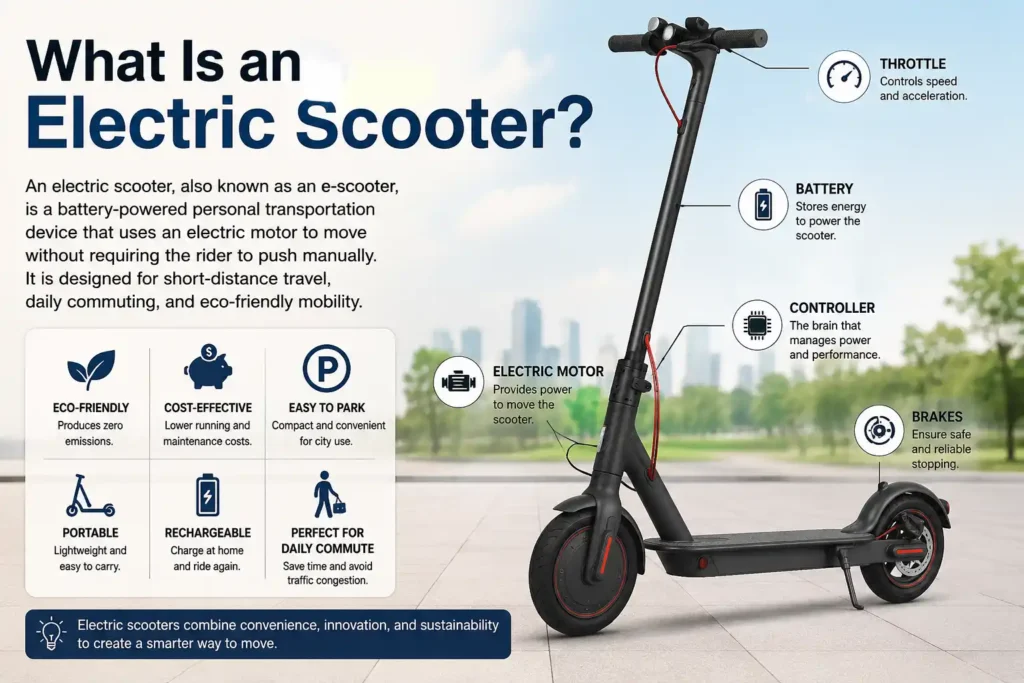
What Is an Electric Scooter?
Electric scooters have rapidly become one of the most popular forms of personal transportation worldwide. Combining convenience, efficiency, and modern technology, they offer a practical solution for short- and medium-distance travel. Whether you’re commuting to work, running errands, or simply enjoying a ride around town, an electric scooter provides a simple and eco-friendly way to get from one place to another.
To understand why electric scooters have gained so much popularity, it’s important to know what they are, how they differ from traditional scooters, and who uses them today.
Definition of an Electric Scooter
An electric scooter, often referred to as an e-scooter or e scooter, is a battery-powered personal mobility vehicle designed to transport riders without requiring manual effort. Unlike traditional kick scooters, which rely on pushing with your foot to generate movement, electric scooters use a rechargeable battery and electric motor to propel the rider forward.
Most modern electric scooters consist of several key components, including:
- A rechargeable battery
- An electric motor
- A throttle for acceleration
- A braking system
- A standing deck
- Handlebars for steering
- Tires and suspension components
When the rider presses the throttle, electricity flows from the battery to the motor, causing the wheels to rotate and move the scooter forward. This simple yet effective system makes electric scooters easy to operate, even for beginners.
Today’s e-scooters are available in various sizes and performance levels, ranging from lightweight commuter models to high-performance scooters capable of traveling long distances and reaching impressive speeds.
How an E-Scooter Differs from a Traditional Scooter
At first glance, an electric scooter and a traditional kick scooter may look similar, but they operate in very different ways.
The biggest difference is the source of power. A traditional scooter depends entirely on the rider’s physical effort. To move forward, the rider must repeatedly push off the ground with one foot. In contrast, an electric scooter uses a motor powered by a rechargeable battery, allowing riders to travel with minimal physical exertion.
Here are some key differences:
| Feature | Electric Scooter | Traditional Scooter |
|---|---|---|
| Power Source | Electric Motor & Battery | Human Power |
| Physical Effort | Minimal | High |
| Speed | Faster | Slower |
| Range | Longer Distances | Limited by Rider Stamina |
| Convenience | High | Moderate |
| Commuting Suitability | Excellent | Limited |
Electric scooters are particularly beneficial for commuters because they allow users to travel farther distances without becoming tired. They also offer greater convenience for daily transportation, especially in urban environments where traffic congestion and parking issues are common.
Who Uses Electric Scooters Today?
One of the reasons electric scooters have become so successful is their versatility. They appeal to a wide range of users with different transportation needs and lifestyles.
Office Workers
Many professionals use electric scooters for daily commuting. They provide a quick and affordable way to travel between home, public transportation stations, and workplaces while avoiding traffic delays.
Students
College and university students often choose e-scooters because they are economical, portable, and easy to store in dormitories or apartments.
Urban Commuters
People living in cities use electric scooters to navigate crowded streets, reduce commuting times, and avoid the hassle of finding parking spaces.
Recreational Riders
Not everyone rides an electric scooter for practical reasons. Many people enjoy them simply for recreation, leisure rides, and exploring parks or neighborhoods.
Delivery and Gig Workers
Food delivery riders and gig economy workers increasingly rely on electric scooters due to their low operating costs and ability to move efficiently through busy urban areas.
Eco-Conscious Individuals
As awareness of environmental issues continues to grow, many people are turning to electric scooters as a greener alternative to cars and motorcycles for short-distance travel.
Why Electric Scooters Appeal to So Many People
Electric scooters combine affordability, convenience, portability, and sustainability in a way that few other transportation options can match. Their ability to serve different types of riders—from daily commuters to casual users—has played a major role in their rapid adoption around the world.
As cities continue to embrace cleaner and smarter mobility solutions, electric scooters are becoming an increasingly important part of modern transportation systems.
How Does an Electric Scooter Work?
“A simple push of the throttle triggers a surprisingly sophisticated chain of technology.”
One of the most common questions among first-time riders is: How does an electric scooter actually work? While riding an e-scooter feels effortless, several advanced components work together behind the scenes to deliver smooth, efficient, and reliable performance.
From the battery and controller to the motor and wheels, every part plays a crucial role in transforming stored electrical energy into forward motion. Understanding this process can help you appreciate the technology behind electric scooters and make more informed decisions when buying or maintaining one.
The Basic Working Principle
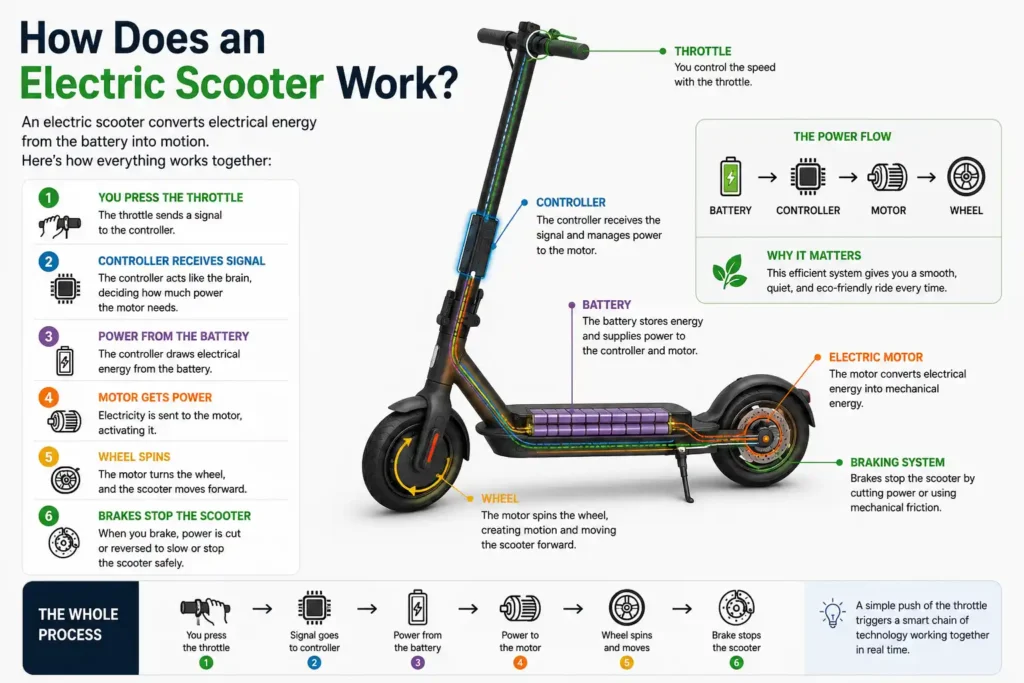
At its core, an electric scooter operates by converting electrical energy into mechanical energy. The process begins with a rechargeable battery that stores electricity. When the rider activates the throttle, the stored energy is sent through an electronic controller to the motor, which then turns the wheels and propels the scooter forward.
The entire system is designed to provide instant acceleration, efficient power delivery, and smooth speed control.
The basic operating sequence looks like this:
- Battery stores electrical energy.
- Rider presses the throttle.
- Controller processes the throttle input.
- Motor receives power from the battery.
- Motor rotates the wheel.
- Scooter moves forward.
Although the process happens in a fraction of a second, multiple components communicate continuously to ensure a safe and responsive riding experience.
What Happens When You Press the Throttle?
The throttle acts as the rider’s control over the scooter’s speed and acceleration. Most electric scooters use either a thumb throttle, finger throttle, or twist-grip throttle mounted on the handlebars.
When you press the throttle:
- A signal is sent to the scooter’s controller.
- The controller calculates how much power is needed.
- The controller draws electricity from the battery.
- Power is delivered to the motor.
- The motor begins spinning faster or slower depending on throttle input.
The more pressure applied to the throttle, the more power is sent to the motor, resulting in greater acceleration and higher speeds.
Modern electric scooters use sophisticated electronic systems that ensure acceleration remains smooth and predictable rather than sudden or jerky.
How Electricity Turns Into Motion
The magic of an electric scooter lies in its ability to transform invisible electrical energy into physical movement.
Inside the motor are powerful magnets and coils of wire. When electricity flows through these coils, it creates a magnetic field. This magnetic interaction causes the motor’s internal components to rotate rapidly.
As the motor spins:
- Rotational energy is generated.
- The wheel attached to the motor begins turning.
- Friction between the tire and the ground creates traction.
- The scooter moves forward.
Most modern electric scooters use brushless DC motors (BLDC motors) because they are highly efficient, durable, and require very little maintenance.
Compared to traditional combustion engines, electric motors deliver instant torque, meaning riders experience immediate acceleration without the delay associated with gear changes or engine revving.
Understanding the Power Flow From Battery to Wheel
To fully understand how an electric scooter works, it’s helpful to visualize the journey electricity takes through the system.
Step 1: Battery Stores Energy
The battery acts as the scooter’s fuel source. Most modern e-scooters use lithium-ion batteries because they are lightweight, energy-dense, and capable of delivering consistent power.
Step 2: Controller Manages Power Distribution
The controller functions as the scooter’s central processing unit. It receives commands from the throttle and determines exactly how much power should be delivered to the motor.
The controller also manages:
- Speed regulation
- Power efficiency
- Battery protection
- Safety features
- Regenerative braking systems (on some models)
Step 3: Motor Converts Electricity Into Rotation
Once the controller sends power to the motor, electrical energy is converted into rotational motion. Depending on the scooter design, the motor may be located in the front wheel, rear wheel, or both wheels in dual-motor models.
Step 4: Wheel Transfers Motion to the Road
As the motor rotates, the wheel spins and creates traction against the ground. This traction generates forward movement, carrying the rider smoothly along the road or pathway.
Step 5: Braking System Controls Speed
When the rider releases the throttle or applies the brakes, the controller reduces power to the motor. Mechanical, electronic, or regenerative braking systems then slow the scooter safely and efficiently.
The Technology Working Behind Every Ride
Although riding an electric scooter feels simple, the technology behind it is remarkably advanced. Every ride involves a coordinated interaction between the battery, controller, motor, throttle, and braking systems. Together, these components create a transportation solution that is efficient, environmentally friendly, and surprisingly powerful.
Understanding how electricity flows from the battery to the wheel not only helps riders appreciate the engineering behind modern e-scooters but also provides valuable insight into choosing, maintaining, and safely operating an electric scooter.
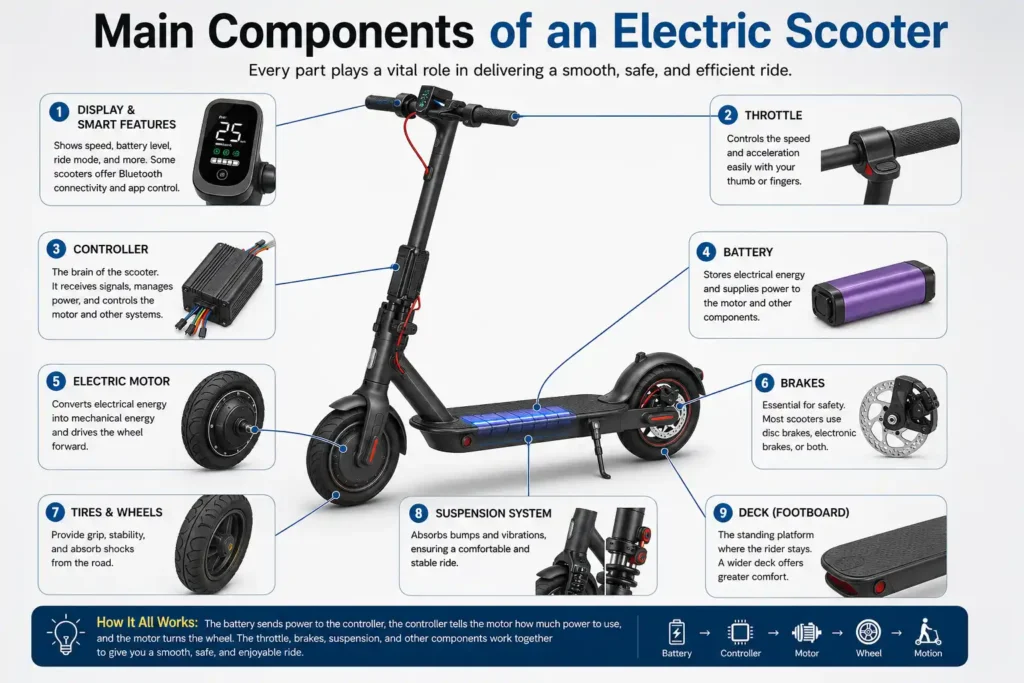
Main Components of an Electric Scooter
An electric scooter may look simple from the outside, but beneath its sleek design lies a combination of advanced components working together to deliver a smooth, safe, and efficient riding experience. Understanding these key parts can help you choose the right scooter, diagnose common issues, and maintain optimal performance over time.
From the battery that powers the ride to the motor that drives the wheels, every component plays a vital role in how an e-scooter performs on the road.
Battery – The Heart of the Scooter
The battery is arguably the most important component of an electric scooter. It serves as the primary energy source, storing the electricity needed to power the motor and all electronic systems.
Most modern electric scooters use lithium-ion batteries because they offer:
- Higher energy density
- Faster charging times
- Longer lifespan
- Lighter weight
- Better overall efficiency
Battery capacity is typically measured in watt-hours (Wh) and directly affects how far a scooter can travel on a single charge. A larger battery generally provides greater range but may also increase the scooter’s weight and cost.
The battery influences several important performance factors, including:
- Riding range
- Acceleration
- Maximum speed
- Charging time
- Overall lifespan
For many riders, battery quality is one of the most important factors to consider when purchasing an electric scooter.
Electric Motor – The Power Source
The electric motor is responsible for converting stored electrical energy into mechanical movement. Without the motor, the scooter would simply be a stationary platform.
Most e-scooters use brushless DC (BLDC) hub motors, which are integrated directly into one or both wheels. These motors are known for their:
- High efficiency
- Quiet operation
- Low maintenance requirements
- Long-term durability
Motor power is measured in watts (W), with common ratings ranging from 250W for entry-level scooters to over 5000W for high-performance models.
A more powerful motor generally provides:
- Faster acceleration
- Better hill-climbing ability
- Higher top speeds
- Improved performance under heavy loads
Some premium electric scooters feature dual motors that deliver power to both wheels for enhanced traction and performance.
Controller – The Scooter’s Brain
If the battery is the heart of the scooter, the controller is undoubtedly its brain.
The controller is an electronic device that manages communication between the battery, motor, throttle, and other systems. It regulates how much power flows to the motor based on rider input and operating conditions.
The controller performs several critical functions:
- Managing acceleration
- Regulating speed
- Protecting the battery
- Monitoring motor performance
- Controlling regenerative braking systems
- Preventing overheating
Advanced controllers help deliver smoother acceleration, improved efficiency, and enhanced safety during operation.
Without the controller, the scooter would be unable to interpret rider commands or distribute power effectively.
Throttle – Speed Control System
The throttle is the rider’s primary control for acceleration and speed management. Located on the handlebars, it allows users to adjust speed with minimal effort.
Common throttle designs include:
- Thumb throttles
- Finger throttles
- Twist-grip throttles
When the rider engages the throttle, an electronic signal is sent to the controller. The controller then determines how much power should be delivered to the motor.
The throttle provides precise control over:
- Starting speed
- Acceleration rate
- Cruising speed
- Overall riding comfort
Modern throttle systems are designed to deliver smooth and predictable acceleration, making electric scooters easy to ride even for beginners.
Brakes – Essential Safety Mechanism
No matter how powerful or fast an electric scooter is, its braking system is equally important. Effective brakes allow riders to maintain control and stop safely in a variety of conditions.
Most electric scooters use one or more of the following braking systems:
Electronic Brakes
These use the motor to slow the scooter by reducing rotational force.
Disc Brakes
Disc brakes provide strong stopping power and are commonly found on mid-range and premium scooters.
Drum Brakes
Enclosed within the wheel hub, drum brakes require less maintenance and offer reliable performance.
Hydraulic Brakes
Hydraulic systems provide the highest level of braking performance and are typically used on high-speed scooters.
Many modern scooters combine multiple braking systems to maximize safety and reduce stopping distances.
Tires and Wheels
The tires and wheels are the only parts of the scooter that make direct contact with the ground, making them critical for stability, traction, and comfort.
Electric scooters typically feature either:
Pneumatic (Air-Filled) Tires
Advantages:
- Better shock absorption
- Improved ride comfort
- Enhanced grip on uneven surfaces
Disadvantages:
- Susceptible to punctures
Solid Tires
Advantages:
- Puncture-proof
- Minimal maintenance
Disadvantages:
- Less comfortable on rough roads
Wheel sizes generally range from 8 to 12 inches, with larger wheels offering improved stability and smoother rides over bumps and cracks.
Suspension System
The suspension system helps absorb shocks and vibrations caused by uneven terrain, potholes, and rough road surfaces.
While some basic scooters rely solely on tire cushioning, many modern models include dedicated suspension systems for improved comfort.
Common suspension types include:
- Spring suspension
- Hydraulic suspension
- Rubber suspension
- Dual suspension systems
Benefits of a good suspension system include:
- Increased rider comfort
- Better handling
- Reduced fatigue during long rides
- Improved control on rough surfaces
For riders who regularly travel on imperfect roads, suspension can make a significant difference in overall ride quality.
Display and Smart Features
Today’s electric scooters are far more advanced than earlier models. Many now include digital displays and smart connectivity features that enhance the riding experience.
A typical display screen may show:
- Current speed
- Battery level
- Riding mode
- Trip distance
- Total mileage
- Error notifications
Premium scooters often offer additional smart features such as:
- Bluetooth connectivity
- Smartphone apps
- GPS tracking
- Anti-theft systems
- Cruise control
- Firmware updates
- Ride statistics
These technologies provide greater convenience, improved security, and more control over scooter performance.
How These Components Work Together
Every component of an electric scooter is interconnected. The battery supplies power, the controller manages energy flow, the motor generates movement, the throttle controls speed, and the braking and suspension systems ensure safety and comfort. Meanwhile, the tires maintain traction, and smart displays keep riders informed.
Together, these components create the seamless riding experience that has made electric scooters one of the fastest-growing forms of personal transportation in the world. Understanding how each part functions will help you become a more informed rider and make better decisions when selecting your next e-scooter.
Types of Electric Scooters
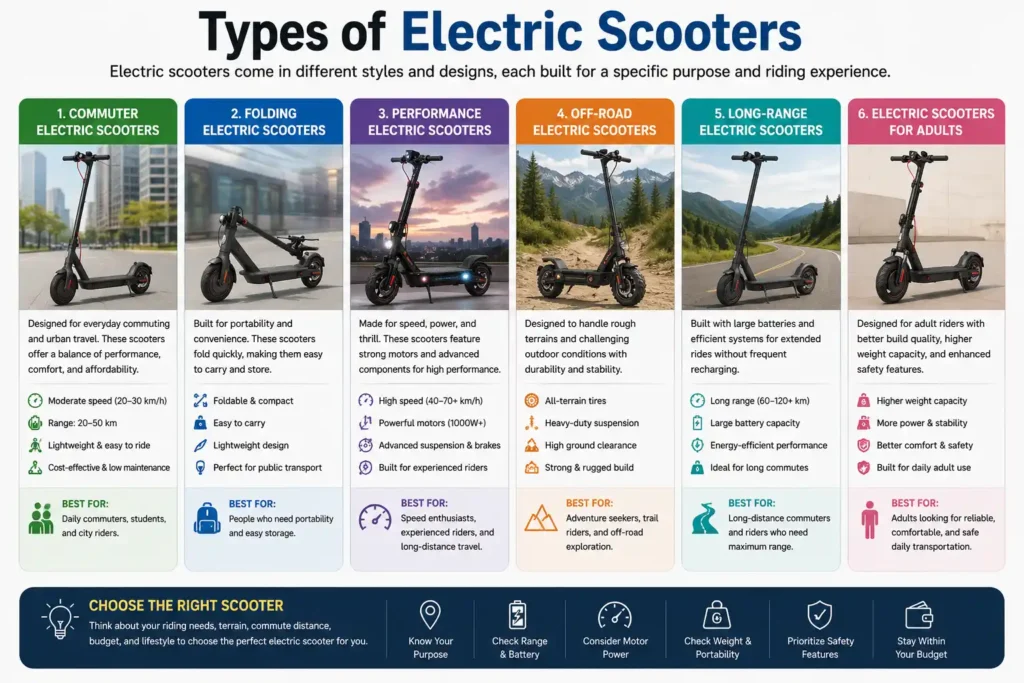
Not all electric scooters are built for the same purpose. While some models are designed for short daily commutes, others focus on high-speed performance, off-road adventures, or extended travel distances. Understanding the different types of electric scooters can help you choose a model that best matches your lifestyle, riding habits, and budget.
Whether you’re a beginner looking for a simple commuter scooter or an experienced rider seeking advanced performance, there’s an e-scooter designed specifically for your needs.
Commuter Electric Scooters
Commuter electric scooters are the most popular category on the market. They are designed to provide a practical, efficient, and affordable transportation solution for daily urban travel.
These scooters typically offer a balance of portability, battery range, speed, and comfort, making them ideal for navigating city streets and reducing reliance on cars or public transport.
Key Features
- Lightweight construction
- Moderate top speeds
- Good battery efficiency
- Easy maneuverability
- Affordable pricing
- Low maintenance requirements
Best For
- Office workers
- Students
- Daily commuters
- First-time riders
Most commuter scooters provide a range of 20–50 kilometers per charge, which is more than enough for typical daily travel.
Folding Electric Scooters
Folding electric scooters are designed with portability in mind. Their compact design allows riders to fold and carry them easily when not in use.
This feature makes them especially useful for people who combine multiple forms of transportation during their commute, such as buses, trains, or rideshares.
Key Features
- Foldable frame design
- Lightweight materials
- Compact storage size
- Easy transportation
- Quick folding mechanisms
Benefits
- Convenient for apartments and offices
- Easy to store under desks
- Ideal for public transportation users
- Reduced parking concerns
Many modern folding scooters can be folded within seconds, making them highly practical for urban lifestyles.
Performance Electric Scooters
Performance electric scooters are built for riders who want more power, higher speeds, and advanced features. These scooters often feature larger motors, stronger batteries, and premium components designed for demanding use.
Unlike commuter scooters, performance models prioritize acceleration and riding excitement.
Key Features
- Powerful motors
- Dual-motor configurations
- Higher top speeds
- Advanced suspension systems
- Premium braking systems
- Enhanced durability
Suitable For
- Experienced riders
- Enthusiasts
- Long-distance commuters
- Riders seeking maximum performance
Performance scooters often reach speeds well beyond standard commuter models and are capable of handling steep hills and challenging riding conditions with ease.
Off-Road Electric Scooters
Off-road electric scooters are specifically engineered to handle rough terrain, dirt trails, gravel paths, and uneven surfaces. They feature rugged construction and enhanced suspension systems to provide stability and comfort outside paved roads.
For adventure seekers, off-road scooters open up a completely different riding experience.
Key Features
- Large all-terrain tires
- Heavy-duty suspension
- High ground clearance
- Powerful motors
- Durable frame construction
Ideal Riding Environments
- Dirt paths
- Forest trails
- Gravel roads
- Rural areas
- Outdoor recreational routes
Because of their robust design, off-road scooters are generally heavier than commuter models but offer significantly greater capability on challenging terrain.
Long-Range Electric Scooters
For riders who regularly travel longer distances, long-range electric scooters provide extended battery capacity and improved energy efficiency.
These scooters are designed to minimize range anxiety and reduce the need for frequent charging.
Key Features
- High-capacity lithium batteries
- Efficient motor systems
- Optimized energy management
- Comfortable riding ergonomics
- Extended travel capability
Advantages
- Fewer charging stops
- Better suitability for long commutes
- Greater travel flexibility
- Ideal for daily high-mileage riders
Some premium long-range electric scooters can travel over 100 kilometers on a single charge under ideal conditions, making them a viable alternative to traditional transportation for many users.
Electric Scooters for Adults
Electric scooters for adults represent one of the fastest-growing segments of the market. Unlike children’s scooters, these models are designed to support higher weight capacities, greater performance demands, and daily transportation needs.
Manufacturers now offer adult-focused scooters in virtually every category, from lightweight commuter models to powerful long-range machines.
Features Commonly Found in Adult Electric Scooters
- Larger decks for improved stability
- Higher weight limits
- More powerful motors
- Enhanced braking systems
- Better suspension
- Longer battery range
Popular Uses
- Daily commuting
- Running errands
- Recreational riding
- Last-mile transportation
- Weekend exploration
Modern electric scooters for adults combine convenience, comfort, and practicality, making them an attractive option for anyone seeking a flexible transportation solution.
Which Type of Electric Scooter Is Right for You?
Choosing the right electric scooter depends largely on how and where you plan to ride. If your primary goal is commuting to work, a commuter or folding scooter may be the perfect fit. Riders looking for speed and excitement may prefer a performance model, while outdoor enthusiasts will benefit from an off-road scooter’s rugged capabilities.
For those who travel longer distances, a long-range scooter can provide the freedom to ride farther without worrying about battery life. And for adults seeking a reliable, everyday transportation option, there are now countless models specifically designed to meet the demands of modern urban living.
By understanding the different types of electric scooters available, you can confidently select a model that delivers the right balance of performance, comfort, range, and value for your individual needs.
Why Are Electric Scooters So Popular?
“A scooter isn’t just transportation—it’s a smarter way to move through modern cities.”
Over the past few years, electric scooters have evolved from a niche mobility solution into a mainstream mode of transportation. Whether you’re walking through a busy city center, a university campus, or a residential neighborhood, chances are you’ll see people riding e-scooters for work, errands, or leisure.
Their growing popularity isn’t accidental. Electric scooters solve many of the everyday transportation challenges faced by modern commuters. They offer an affordable, environmentally friendly, and highly convenient alternative to cars, motorcycles, and even public transportation in certain situations.
Let’s explore the key reasons why millions of people around the world are choosing electric scooters as their preferred way to travel.
Lower Transportation Costs
One of the biggest advantages of owning an electric scooter is the significant reduction in transportation expenses. With rising fuel prices and increasing vehicle maintenance costs, many commuters are looking for more economical ways to get around.
Electric scooters are incredibly cost-effective because they consume very little electricity. Charging a scooter battery typically costs only a small fraction of what drivers spend on gasoline or diesel for a similar trip.
In addition to lower energy costs, electric scooter owners often save money on:
- Fuel expenses
- Parking fees
- Vehicle maintenance
- Public transportation fares
- Insurance costs (where applicable)
For people who commute daily, these savings can add up substantially over time, making an electric scooter a smart long-term investment.
Eco-Friendly Travel
As environmental concerns continue to grow, many individuals are seeking cleaner transportation options that reduce their carbon footprint. Electric scooters have emerged as one of the most environmentally friendly forms of personal mobility.
Unlike traditional fuel-powered vehicles, electric scooters produce zero direct emissions during operation. They help reduce air pollution, lower greenhouse gas emissions, and contribute to cleaner urban environments.
Some environmental benefits of electric scooters include:
- Reduced fossil fuel consumption
- Lower carbon emissions
- Less noise pollution
- Improved urban air quality
- Reduced traffic-related environmental impact
For eco-conscious commuters, switching to an electric scooter is a simple yet effective way to support more sustainable transportation practices.
Avoiding Traffic Congestion
Traffic congestion is one of the biggest frustrations faced by commuters in cities around the world. Long queues of vehicles, slow-moving traffic, and unpredictable travel times can make even short journeys stressful and inefficient.
Electric scooters offer a practical solution by allowing riders to navigate through urban areas more efficiently than larger vehicles.
Benefits include:
- Faster travel during peak traffic hours
- Easier navigation through crowded streets
- More predictable commute times
- Reduced stress compared to driving in traffic
Because of their compact size, electric scooters can often take advantage of bike lanes, dedicated mobility paths, and alternative routes that are inaccessible to cars.
For many city residents, this ability to bypass traffic congestion is one of the most compelling reasons to switch to an e-scooter.
Easy Parking and Storage
Finding a parking space can be both time-consuming and expensive, particularly in densely populated urban areas. Electric scooters eliminate much of this inconvenience.
Most modern scooters feature foldable designs that make them easy to carry and store when not in use.
Advantages of scooter storage include:
- No need for large parking spaces
- Easy storage at home or work
- Convenient transportation on elevators
- Ability to keep the scooter indoors
- Reduced risk of theft when stored securely
Many riders simply fold their scooter and place it under a desk, in a closet, or beside their workstation, something that would be impossible with a car or motorcycle.
Convenience for Daily Commuting
Perhaps the greatest reason for the popularity of electric scooters is their unmatched convenience.
Modern commuters value transportation solutions that are quick, flexible, and easy to integrate into their daily routines. Electric scooters excel in all of these areas.
They are ideal for:
- Traveling to work
- Running errands
- Visiting nearby shops
- Connecting with public transportation
- Last-mile commuting
- Recreational rides
Unlike cars, electric scooters require minimal preparation before use. There are no fuel stops, lengthy warm-up periods, or parking concerns. Riders can simply unfold the scooter, power it on, and begin their journey within seconds.
For many people, electric scooters provide the perfect balance between mobility, affordability, and practicality.
A Transportation Solution Built for Modern Cities
The popularity of electric scooters continues to grow because they address several of the most common transportation challenges of modern urban life. They help people save money, reduce environmental impact, avoid traffic congestion, simplify parking, and enjoy a more convenient commuting experience.
As cities continue to invest in sustainable transportation infrastructure and electric mobility technologies improve, electric scooters are becoming more than just a trend—they are an important part of the future of urban transportation. For commuters seeking a smarter, cleaner, and more efficient way to travel, it’s easy to see why electric scooters have become such a popular choice worldwide.
How to Choose the Right Electric Scooter
“The best electric scooter isn’t the fastest one—it’s the one that fits your lifestyle.”
With hundreds of electric scooter models available on the market, choosing the right one can feel overwhelming. From battery range and motor power to portability and price, there are many factors to consider before making a purchase.
The good news is that you don’t need the most expensive or fastest scooter to enjoy a great riding experience. The ideal e-scooter is one that matches your daily travel needs, budget, and riding preferences.
Before buying an electric scooter, take the time to evaluate the following key factors.
Consider Your Daily Commute
The first step in choosing the right electric scooter is understanding how you plan to use it.
Ask yourself:
- How far do you travel each day?
- Will you ride mostly on city streets or rough roads?
- Do you need a scooter for work, school, or leisure?
- Will you carry it on public transportation?
- Do you encounter hills during your commute?
For short urban commutes, a lightweight commuter scooter may be all you need. However, if you regularly travel longer distances or face steep inclines, you’ll likely benefit from a model with a larger battery and more powerful motor.
Choosing a scooter based on your actual riding habits helps avoid overspending on features you may never use.
Choosing the Right Battery Range
Battery range is one of the most important specifications to consider when buying an electric scooter. It determines how far you can travel on a single charge before needing to recharge.
Manufacturers often advertise maximum range figures achieved under ideal conditions. In real-world riding situations, factors such as rider weight, terrain, speed, weather, and road conditions can reduce actual range.
A smart rule is to choose a scooter with at least 25–30% more range than your typical daily travel distance.
Recommended Range Based on Usage
| Daily Travel Distance | Recommended Scooter Range |
|---|---|
| Up to 10 km | 20–25 km |
| 10–20 km | 30–40 km |
| 20–30 km | 40–60 km |
| 30+ km | 60 km or more |
Selecting a scooter with sufficient range ensures you can complete your journeys comfortably without worrying about running out of battery power.
Understanding Motor Power
The motor is responsible for acceleration, speed, and hill-climbing performance. Motor power is measured in watts (W), and understanding these ratings can help you select a scooter that meets your expectations.
General Motor Power Guide
| Motor Power | Best For |
|---|---|
| 250W–350W | Short commutes and flat terrain |
| 500W–750W | Daily commuting and moderate hills |
| 1000W–2000W | Long distances and steep inclines |
| 2000W+ | High-performance riding |
While a more powerful motor offers better acceleration and climbing ability, it also tends to consume more battery power and increase the scooter’s cost.
For most adult commuters, a motor between 500W and 1000W provides an excellent balance of performance and efficiency.
Portability and Weight
If you frequently carry your scooter or combine it with public transportation, portability becomes a crucial factor.
Electric scooters vary significantly in weight. Lightweight commuter models can weigh less than 15 kg, while high-performance scooters may exceed 35 kg.
Consider portability if you need to:
- Carry the scooter upstairs
- Store it in an apartment
- Place it in a car trunk
- Bring it into an office
- Use trains or buses regularly
What to Look For
- Folding mechanism
- Compact design
- Carrying handle
- Lightweight frame materials
- Secure locking system when folded
A scooter that’s too heavy for your daily routine can quickly become inconvenient, no matter how powerful it is.
Budget Considerations
Electric scooters are available at a wide range of price points, making it important to establish a realistic budget before shopping.
While budget models may seem attractive, extremely cheap scooters often compromise on battery quality, safety features, and durability.
Typical Electric Scooter Price Categories
| Category | Price Range |
|---|---|
| Entry-Level | $250–$500 |
| Mid-Range | $500–$1,000 |
| Premium | $1,000–$2,000 |
| Performance Models | $2,000+ |
For most riders, mid-range scooters offer the best balance of quality, performance, and reliability.
Rather than focusing solely on the purchase price, consider the scooter’s overall value, including battery lifespan, build quality, warranty coverage, and maintenance requirements.
Features Worth Paying For
Modern electric scooters come with a variety of features, but not all of them provide equal value. Some upgrades can significantly improve safety, comfort, and convenience.
High-Value Features
Reliable Braking System
Quality disc or hydraulic brakes provide better stopping power and increase rider safety.
Suspension System
A good suspension improves comfort on uneven roads and reduces rider fatigue.
Larger Tires
Larger pneumatic tires offer better grip, stability, and shock absorption.
Water Resistance
A higher water-resistance rating helps protect the scooter from light rain and wet conditions.
Bright Lighting
Powerful front and rear lights improve visibility during nighttime riding.
Smart Display
Digital displays provide useful information such as:
- Current speed
- Battery level
- Riding mode
- Trip distance
Mobile App Connectivity
Some advanced scooters offer smartphone integration for:
- Ride tracking
- Security settings
- Firmware updates
- Performance customization
Features You May Not Need
Many buyers are tempted by extremely high top speeds or advanced racing-style features. However, for everyday commuting, reliability, comfort, and battery range are often more important than maximum performance.
Focus on features that improve your daily riding experience rather than paying extra for specifications you’ll rarely use.
Choose for Your Needs, Not the Marketing
Many first-time buyers make the mistake of choosing an electric scooter based solely on speed or appearance. In reality, the best scooter is the one that fits your routine, commute distance, storage requirements, and budget.
By carefully considering your daily travel needs, battery range, motor power, portability, and essential features, you’ll be able to find an electric scooter that delivers years of reliable and enjoyable riding.
A well-chosen electric scooter isn’t just a purchase—it’s an investment in a more convenient, efficient, and enjoyable way to travel.
H2: Frequently Asked Questions About Electric Scooters
What Is an Electric Scooter?
An electric scooter, also known as an e-scooter or e scooter, is a battery-powered personal transportation vehicle that uses an electric motor to move without requiring the rider to push manually. It typically consists of a rechargeable battery, motor, throttle, brakes, handlebars, and a standing deck. Electric scooters are widely used for commuting, short-distance travel, and recreational riding due to their convenience, affordability, and eco-friendly operation.
How Does an Electric Scooter Work?
An electric scooter works by converting electrical energy stored in its battery into mechanical energy that drives the wheels. When the rider presses the throttle, a signal is sent to the controller, which regulates the flow of electricity from the battery to the motor. The motor then rotates the wheel, propelling the scooter forward. Modern e-scooters use advanced electronic systems to ensure smooth acceleration, efficient power delivery, and reliable braking performance.
Are Electric Scooters Worth Buying?
Yes, electric scooters are worth buying for many people, especially commuters and urban residents. They offer several advantages, including:
Lower transportation costs
Reduced fuel expenses
Eco-friendly travel
Easy parking and storage
Faster travel in congested areas
Convenient last-mile transportation
For individuals who regularly travel short to medium distances, an electric scooter can provide significant long-term savings and convenience compared to cars, motorcycles, or public transport.
How Long Do Scooter Batteries Last?
The lifespan of an electric scooter battery depends on its quality, usage, and maintenance. Most modern lithium-ion batteries last between 500 and 1,000 charging cycles, which typically translates to 3 to 5 years of regular use.
To maximize battery lifespan:
Avoid fully draining the battery frequently.
Use the manufacturer-approved charger.
Store the scooter in moderate temperatures.
Charge the battery regularly, even during periods of inactivity.
Proper battery care can significantly extend the overall life and performance of your electric scooter.
Can Electric Scooters Be Used Every Day?
Absolutely. Electric scooters are designed for daily use and are commonly used by office workers, students, and city commuters around the world.
Daily riders benefit from:
Lower transportation costs
Reduced commuting time
Easy maneuverability
Convenient storage
Minimal operating expenses
As long as the scooter is properly maintained and charged, it can serve as a reliable everyday transportation solution.
Do Electric Scooters Need Maintenance?
Yes, although electric scooters require significantly less maintenance than cars or motorcycles, regular upkeep is still important to ensure safety and optimal performance.
Basic maintenance tasks include:
Checking tire pressure and condition
Inspecting brakes regularly
Tightening loose bolts and screws
Cleaning the scooter
Monitoring battery health
Checking lights and electrical connections
Routine maintenance helps prevent unexpected breakdowns and extends the lifespan of the scooter.
Conclusion: Is an Electric Scooter Right for You?
Electric scooters have quickly become one of the most practical and innovative transportation solutions for modern life. They combine affordability, convenience, portability, and sustainability in a way that few other vehicles can match. Whether you’re commuting to work, traveling across campus, running daily errands, or simply looking for a fun way to get around, an electric scooter can make your journeys faster, easier, and more enjoyable.
As we’ve explored throughout this guide, today’s e-scooters offer a wide range of options to suit different riders and lifestyles. From lightweight commuter models and foldable scooters to high-performance and long-range machines, there’s an electric scooter designed for virtually every need and budget.
Before making a purchase, consider factors such as your daily travel distance, battery range requirements, motor power, portability needs, and overall budget. Choosing a scooter that aligns with your lifestyle will ensure you get the best value and riding experience.
With rising fuel costs, increasing traffic congestion, and growing environmental awareness, electric scooters are more than just a trend—they represent the future of personal urban mobility. Their ability to provide efficient, eco-friendly transportation makes them an attractive choice for millions of riders worldwide.
Ready to Find Your Perfect Electric Scooter?
Whether you’re looking to save money, shorten your commute, or enjoy a cleaner way to travel, an electric scooter offers a practical and exciting solution. Explore our expert scooter guides, in-depth reviews, maintenance tips, and buying advice to find the perfect e-scooter for your needs.
Start your electric mobility journey today and discover why more people than ever are choosing electric scooters as their preferred way to travel. 🛴⚡🚀